


Last Updated: November 3, 2026
Quick Summary
To use a spinning reel, open the bail, cast by releasing the line with your index finger as the rod swings forward, then close the bail and reel in to take up slack. Spool the line under steady tension, fill it just below the lip, and set the drag before you fish.
- Learn the main parts first: spool, bail, handle, drag and rotor.
- Fill the spool to just below the lip so line does not bunch or tangle.
- Practise casting at a 10-metre target until you land six out of ten within a metre.
- Set the drag to about one third of your line's strength before your first cast.
- Never lock the drag down hard to stop a running fish, because the line will break.
Table of Contents
- Identify the Parts of a Spinning Reel
- Choose the Right Line and Check Its Capacity
- How to Spool a Spinning Reel Without Twists
- How to Cast a Spinning Reel Step by Step
- How to Set Drag on a Spinning Reel
- How to Retrieve a Spinning Reel and Fight a Fish
- Your Setup Checklist and Next Step Before the First Trip
- Frequently Asked Questions
Identify the Parts of a Spinning Reel
Learning how to use a spinning reel for beginners starts with knowing its parts. At Fergo's Tackle World, the parts list is the first thing new anglers should learn.
A spinning reel is the part of your setup that holds the line and lets you cast and retrieve. Here are the main parts you need to know:
- Spool: The round part that holds your line.
- Bail: The metal arm that loops over the spool to catch the line.
- Handle: The crank you turn to wind in line.
- Drag: The adjustable knob that lets line slip when a fish pulls hard.
- Rotor: The part that spins around the spool and wraps line onto it.
If you're starting out, the Shimano FX FC Spin Reel with Line is a cost-effective, entry-level spinning reel that suits recreational fishing enthusiasts.

Watch out: Don't open the bail by hand while you're holding the line under tension. Flip it open with your finger or the handle, or you can jam the line.
Choose the Right Line and Check Its Capacity
Every reel has a line capacity printed on its spool, usually in pound test and metres. Match your line to that number. Overloading the spool causes the line to bunch up and tangle when you cast.
Monofilament is the most common choice for beginners. It's forgiving, easy to tie, and cheap to replace.
- Check the spool label before you buy line.
- Fill the spool to just below the lip, not to the edge.
- Choose a soft, castable line if you're new to casting.
How to Spool a Spinning Reel Without Twists
Spooling is where most beginners run into trouble. Line twist and wind knots usually start here.
- Tie the line to the spool with an arbor knot or by threading it through the spool hole.
- Hold the spool firmly and wind line on by turning the handle.
- Keep steady tension by pinching the line lightly with a cloth or your fingers.
- Fill to just below the lip.
- Check for twists by letting the line hang and watching for loops.
Watch out: Never reel the line on by holding the spool still while spinning the handle without tension. Loose line will bunch and cause loops and wind knots.
If you see loose loops, stop, reverse the reel slightly and reel back in under steady tension.
How to Cast a Spinning Reel Step by Step
Casting is the skill that takes the most practice, and the fastest way to improve is to treat it like practice rather than just fishing. Start in an open area with no hooks on the line, a lawn, a park, or an open beach, and use a small sinker or a hookless lure as your practice weight.
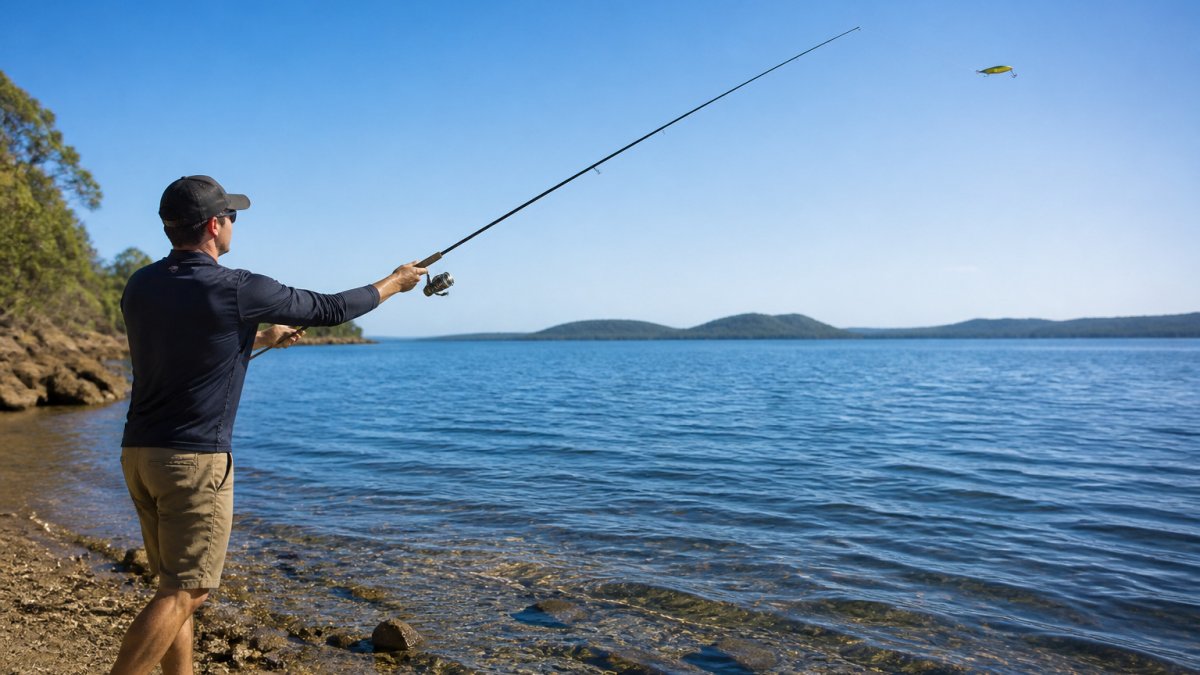
The five-step cast
- Hold the rod with your casting hand on the reel seat, index finger resting on the line in front of the spool.
- Open the bail with your other hand or by flipping it with your finger.
- Bring the rod back behind your shoulder, keeping the line close to the rod and your eye on the target.
- Bring the rod forward smoothly and release the line with your index finger as the rod passes roughly 45 degrees.
- Close the bail once the lure lands, then reel in to take up slack.
A common beginner mistake is releasing the line too early, which sends the lure high and short. Release later for a longer cast. Releasing too late sends it down into the ground in front of you.
Practice drills that actually build skill
The 10-metre target drill. Place a bucket, a hoop, or a marker 10 metres away. Cast at it ten times and count how many land within a metre. Do this at the start of each session until you are landing six or more out of ten. Then move the target to 15 metres and repeat.
The clock-face drill. Pick a fixed point and cast to 12 o'clock, then 3, then 6, then 9, ten casts each. This trains direction control, which matters more than distance when you are fishing around structure.
The no-bail-flip drill. Practise closing the bail with your hand rather than by turning the handle. Closing by hand prevents the line from catching on the bail arm and creating a loose loop on the spool.
The distance ladder. Cast five times at half effort, five at three-quarter effort, and five at full effort. Note where each lands.
Troubleshooting the common casting faults
- Lure goes high and short: you released too early. Let the rod come further forward before releasing.
- Lure dives into the ground: you released too late, or you snapped the rod rather than swinging it smoothly.
- Line loops off the spool mid-cast: the spool is overfilled, or the line was spooled with slack. Strip line back to just below the lip and respool under tension.
- Wind knot after the cast: the line was loose on the spool when the bail opened. Close the bail by hand and check for slack before the next cast.
- Line snaps on the cast: the drag is too tight, the line is old, or there is a nick in a guide. Run the line through your fingers to feel for rough spots.
Safety and casting clearance
Before every cast, look behind you and to both sides. A hookless practice weight still hurts, and a hooked lure can catch a person, a pet, or a car. Keep at least 10 metres of clear space behind you, and never cast over a path or road.
Shimano FX FC Spin Reels with Line →
Check local fishing rules before you fish, as size and bag limits, closed seasons and licence requirements apply. Carry pliers and a cloth for hook removal, and wear glasses if you are casting near other people.
Measuring your progress
Keep a simple log: date, target distance, number of casts, and how many landed within a metre. If accuracy is not improving, film a few casts on your phone and check your release point, it is usually earlier than you think.
How to Set Drag on a Spinning Reel
Drag is the most misunderstood control on a spinning reel, and it is the one that decides whether a good fish becomes a landed fish or a broken line. The drag is a stack of washers inside the spool that lets the spool slip under load. Turning the knob at the front of the spool (or the rear knob on some models) compresses those washers: tighter means more resistance before line escapes, looser means less.
Set it before you cast, not after the fish bites
A common beginner error is leaving the drag cranked down from storage and only thinking about it once a fish is on. Set it on dry land, before your first cast.
- Tie on your lure or a plain sinker, no hook needed for this test.
- Hold the rod at roughly 45 degrees with the line running out through the guides.
- Pull line off the spool by hand, steadily, as if a fish were running.
- Adjust the drag knob until the line slips under firm but not extreme pull.
- Note the feel and check it again after changing lures or line.
The one-third rule, and why it is a starting point
Setting the drag well below your line's breaking strain leaves a safety margin so a hard run is less likely to snap the line at the knot or the rod tip.
You do not need a spring scale to get close. If the rod is bending hard and the line still will not give, the drag is too tight.
Adjusting during a fight
Drag is not set-and-forget. If a fish makes a long run and the line is peeling off too freely, a small clockwise turn of the knob adds resistance.
Watch out: Never lock the drag down hard to stop a running fish. Line that cannot slip will break at the weakest point, usually the knot or the rod tip, and you will lose the fish and the lure.
Drag and line type
Monofilament stretches, so it absorbs some shock and tolerates a slightly tighter drag. Braid has almost no stretch, so a braid setup needs a lighter drag setting and a leader to absorb shock. If you are spooling braid as a beginner, set the drag conservatively and check it more often.
A quick pre-trip drag check
Before every session, pull a metre or two of line off against the drag, feel the resistance, and confirm the knob has not drifted. Store the reel with the drag backed off, compressed washers left tight for months can take a set and give inconsistent release.
The table below summarises the key drag-setting steps and checks covered in this section.
| Step | What to do | Note |
|---|---|---|
| Set before casting | Set drag on dry land before the first cast | Don't wait until a fish bites |
| Test the drag | Pull line off by hand, steadily | Mimic a fish running |
| Starting point | Set drag to about one third of line strength | Leaves a safety margin |
| Mid-fight adjustment | Turn knob an eighth to a quarter turn at a time | Make small changes only |
| Never do this | Lock drag down hard to stop a running fish | Line breaks at the weakest point |
| Pre-trip check | Pull a metre or two of line against drag | Confirm the knob hasn't drifted |
| Storage | Back drag off when storing the reel | Tight washers can take a set |
How to Retrieve a Spinning Reel and Fight a Fish
Retrieving means reeling in your lure at a steady pace. Keep the rod tip up and turn the handle at an even speed. When a fish hits, keep the rod tip up, let the drag do the work on hard runs, and reel steadily when the fish tires.
- Keep the rod tip high when a fish runs.
- Let the drag give line when the fish pulls hard.
- Reel steadily when the fish stops running.
Your Setup Checklist and Next Step Before the First Trip
Before your first trip, run through this checklist:
- Reel matches the rod's line rating
- Line is spooled tight with no twists
- Bail closes and opens smoothly
- Drag is set to about one third of line strength
- You've practised casting on open ground
If you're still choosing your gear, our team at Fergo's Tackle World is happy to help you match a reel, rod and line to the fishing you plan to do.
Frequently Asked Questions
How do you set up a spinning reel for the first time?
Start by mounting the reel onto the rod's reel seat and tightening the locking nut firmly by hand. Then check that the handle turns smoothly and the bail arm opens and closes without catching. Once the reel sits securely, you are ready to add line. The Shimano FX 662 2-4kg and FX2500FC combo at $69.99 from Fergo's Tackle World is described as ideal for beginner and intermediate anglers.
How do you put fishing line on a spinning reel?
Tie the line to the spool with an arbor knot, leaving a short tail, then wind the line onto the spool while keeping light tension on it. Fill the spool to just below the lip so the line sits evenly. Feed the line through the rod guides from the tip down to the reel, and check the manufacturer's line rating printed on the spool or rod to avoid overfilling. Spooling it at the right tension is the key step to avoiding line twist later.
Why does fishing line twist on a spinning reel?
Line twist usually happens when the line is spooled without enough tension, when the lure spins freely, or when the line has been wound on in the wrong direction. Reeling in slowly with the line under tension and letting the lure spin out between casts reduces it. Reels with an anti-twist mechanism help suppress line trouble, but good spooling habits still matter most.


